
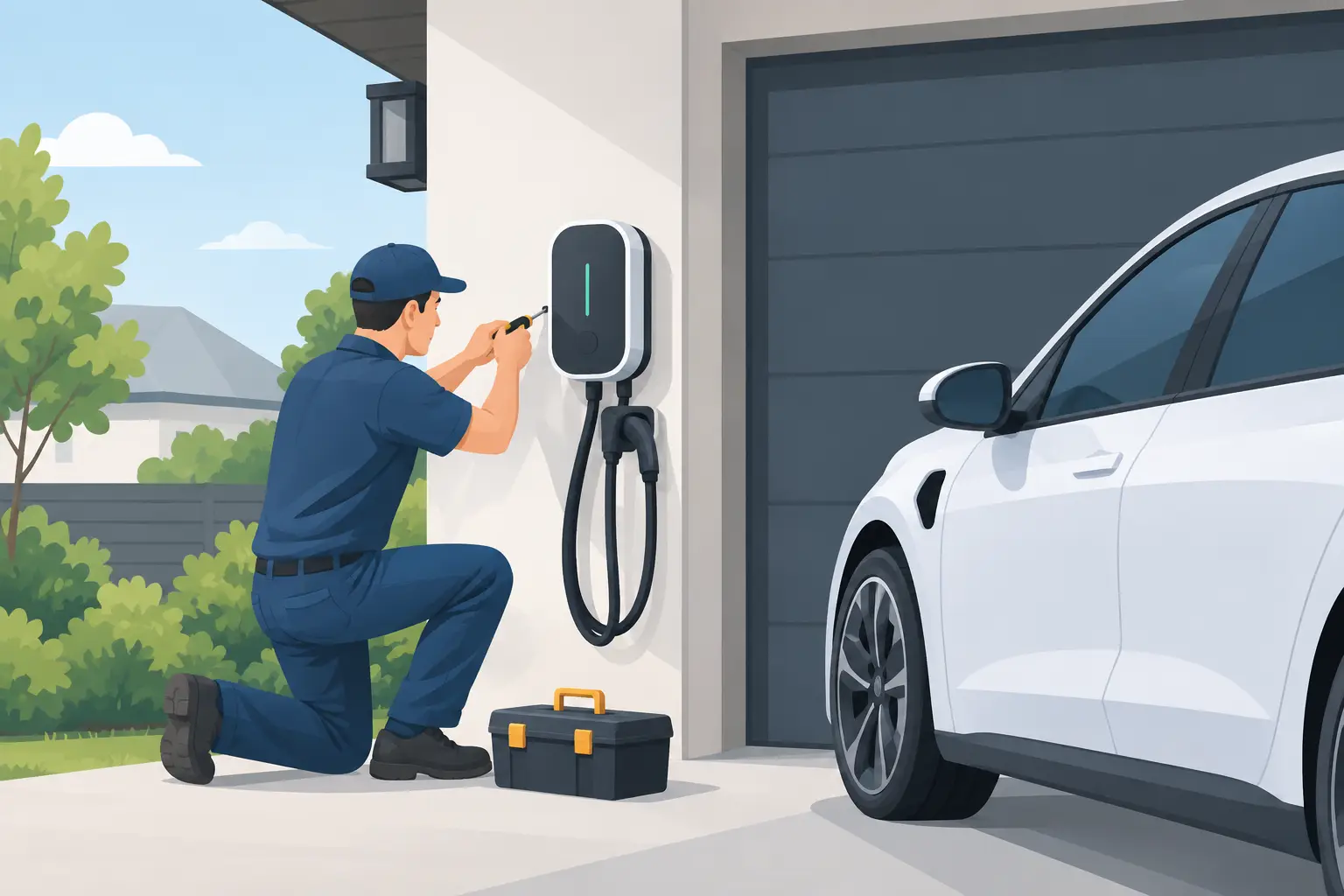
Arriving home with an electric vehicle should mean convenient, dependable charging on your driveway – not relying on public chargers or trailing an unsuitable extension lead through a window. A professionally planned home EV charger installation gives you a safer, quicker way to charge while protecting your property’s electrical system.
For most households, the charger itself is only one part of the decision. The condition and capacity of your existing installation, where you park, your electricity tariff and the route for cabling all affect the right solution. Getting these details checked before work starts avoids surprises on installation day.
What a home EV charger installation involves
A domestic charge point is normally fitted on an external wall near the parking space, or on a purpose-built pedestal where wall mounting is not practical. It is connected to your consumer unit by a correctly sized cable and protected by suitable electrical devices. The installer will test the completed work and provide the appropriate certification.
Many homes can support a 7kW charger, which is a popular choice for overnight charging. Actual charging speed also depends on the vehicle, its onboard charger and the available electrical supply. A charger with a higher stated capacity is not automatically the better option if your vehicle cannot use that capacity or the property supply cannot support it.
The first stage should be a site survey or a detailed assessment of the proposed installation. A qualified electrician will consider the consumer unit, available load capacity, earthing arrangement, cable route, parking position and any obstacles such as paths, garages or outbuildings. They should also discuss how you use the vehicle, rather than simply fitting the first unit available.
The electrical checks that matter
EV charging is a sustained electrical load. This makes the condition of the existing installation particularly relevant, especially in older properties or homes with electric showers, immersion heaters, induction hobs, heat pumps or solar equipment already in use.
Your electrician may identify that the consumer unit needs additional capacity, that protective devices need upgrading, or that a longer cable route requires extra installation work. These are not unnecessary add-ons. They are measures intended to keep the installation safe, compliant and reliable over the long term.
The earthing arrangement also needs careful assessment. Depending on the supply type and charger selected, protective measures may be needed to address the risk associated with a fault in the electricity network. Certified installers understand how to select and install the appropriate protection for the property.
Choosing the right charger for your home
There is no single best charger for every driver. A good choice is one that fits your vehicle, parking arrangement, household demand and preferred way of managing energy costs.
A tethered unit has a charging lead permanently attached. It is convenient for regular use because you simply park, plug in and charge. An untethered unit has a socket, allowing you to use your own cable and potentially keep the front of the property tidier when the charger is not in use. Both can be suitable, provided the equipment is installed correctly and located sensibly.
Smart charging is worth considering for many households. Compatible units can schedule charging for off-peak tariff periods, monitor usage and, in some cases, adjust charging output in response to household demand. App features can be useful, but they should not be the only factor in your decision. Reliable hardware, correct electrical design and an accessible local support option matter more than a long list of features you may never use.
If your Wi-Fi signal does not reach the driveway or garage, mention this at the survey stage. Some chargers have alternative connectivity options, while others may need a practical solution to improve signal coverage. It is better to establish this before selecting a unit with app-based functionality.
Solar panels and EV charging
For households with solar panels, an EV charger can help make better use of electricity generated at home. Some chargers can prioritise surplus solar generation, while others allow charging to be timed around lower-cost grid electricity. The most economical setting depends on your driving routine, electricity tariff, solar output and whether you have battery storage.
Solar-led charging is often slower when generation is limited, particularly during winter or on overcast days. A flexible setup that allows both solar preference and scheduled overnight charging is usually more practical than relying on one charging method alone.
Planning the location and cable route
The ideal charger position is close enough to the vehicle that the cable reaches comfortably without becoming a trip hazard or crossing a public footway. It should be high enough to reduce the chance of impact or water ingress, while remaining easy to use. The charging lead should not be stretched tightly, trapped under a gate or left where it could be damaged.
A short, direct route from the consumer unit can reduce installation complexity, but it is not the only consideration. In some homes, a neat route through a garage, loft, under-floor space or external containment gives a better result than placing the charger at the nearest possible point.
Properties with detached garages, shared drives or parking away from the house may need more planning. Groundworks, armoured cabling, cable protection or a pedestal can all be appropriate. For leasehold homes and shared parking areas, check whether freeholder, managing agent or landowner permission is needed before installation is arranged.
What affects the cost?
The cost of a home EV charger installation is influenced by the charger specification and the work needed to connect it safely. A straightforward fit near a modern consumer unit will usually be less involved than an installation requiring a long cable run, consumer unit alterations, groundwork or a supply upgrade.
It is sensible to ask what the quotation includes. This should cover the charge point, cable route, protective devices, testing, certification and any notification requirements. If potential additional work has been identified, a clear quotation should explain why it may be necessary rather than leaving you to discover it after work begins.
The cheapest quote is not always the best value. Charging equipment should be installed by competent, insured electricians who assess the full electrical system, not just the wall where the unit will sit. Good workmanship can prevent nuisance tripping, damaged cabling, unsuitable protection and costly corrective work later.
Certification, compliance and peace of mind
EV charging work must meet the relevant requirements of BS 7671, the IET Wiring Regulations. In England, certain domestic electrical work may also require notification under Building Regulations. Using a properly registered installer helps ensure the correct certification and notification process is handled.
Once complete, you should receive electrical installation documentation confirming that the work has been inspected and tested. Keep this with your property records. It can be useful for future electrical work, insurance queries, property sales and demonstrating that the charger has been installed professionally.
For landlords and property managers, documentation is especially valuable. It supports a clear maintenance record and helps show that new electrical equipment has been added with safety and compliance in mind. Where an Electrical Installation Condition Report is due, it may be sensible to coordinate the charger project with the wider inspection programme.
Preparing for installation day
Most standard domestic installations can be completed efficiently once the assessment, equipment choice and cable route are agreed. You may need to provide access to the consumer unit, loft, garage or other areas along the cable route, and move vehicles or stored items where necessary.
Before the electrician arrives, confirm which charger is being fitted, where it will be positioned and whether you need help setting up the app or charging schedule. There may be a short interruption to the electricity supply while connections and testing are carried out, so plan around home working, alarms or equipment that should not lose power.
After installation, ask the electrician to explain the charger controls, cable care and any smart charging settings. A well-installed unit should be straightforward to use, but a few minutes of guidance makes it easier to benefit from the system from the first charge.
For homeowners across Tamworth, Nottingham and the wider Midlands, the right starting point is a clear conversation with a qualified electrician. SDT Electrical Services can assess your property, explain the practical options and provide a free, no-obligation quotation for an installation built around how you actually drive and live.