
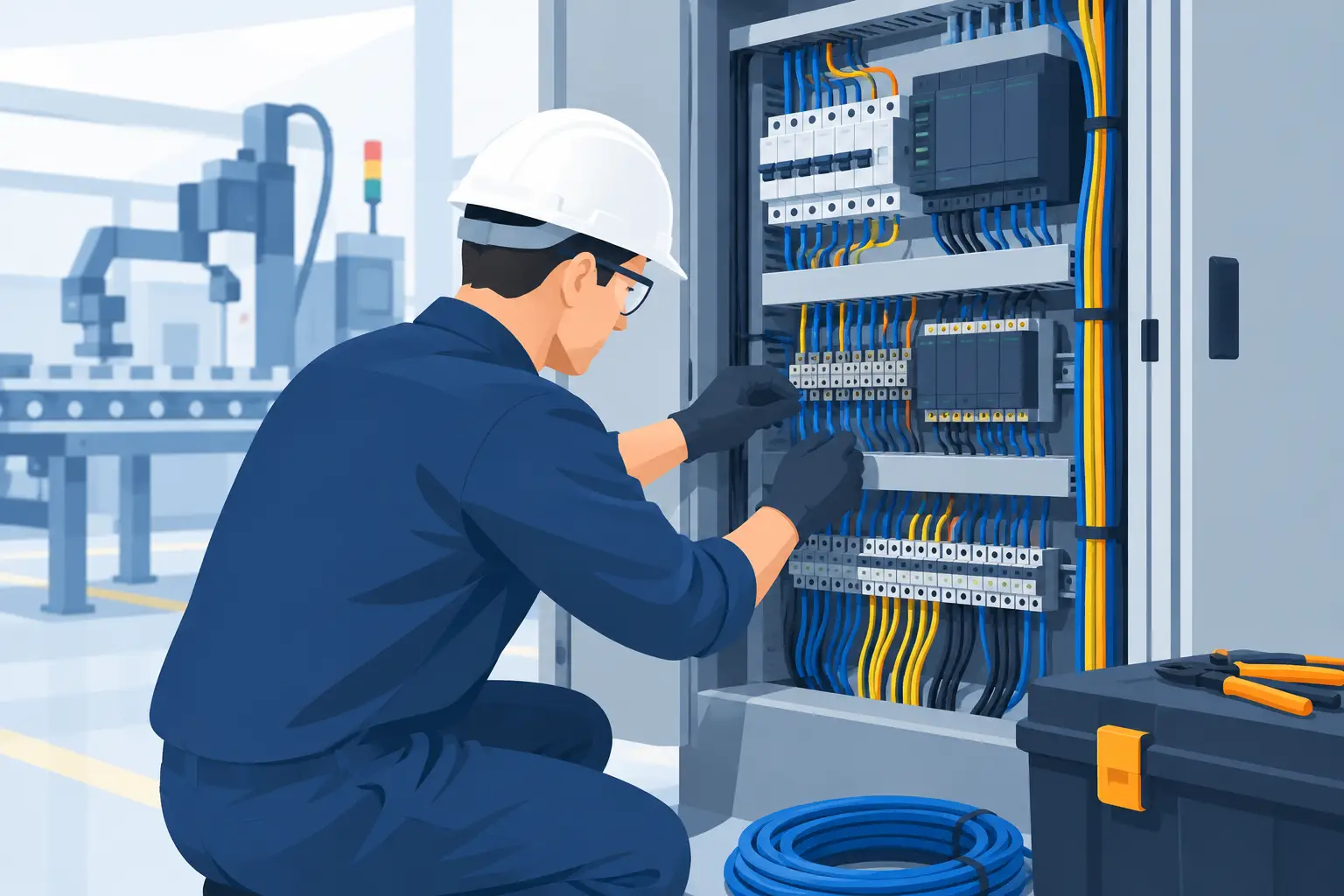
A machine can be mechanically ready, delivered on schedule and positioned perfectly, yet still be unable to run safely without the right electrical connection. Industrial machine wiring services bring together power distribution, control wiring, protective devices and testing so that new or existing equipment can operate as intended without creating avoidable risk for people, premises or production.
For factories, workshops, warehouses and processing sites, the work is rarely as simple as fitting a supply cable. A proper installation must account for the machine’s electrical load, starting current, control requirements, isolation arrangements, location, future maintenance and the condition of the existing installation. Getting those details right at the outset helps prevent nuisance tripping, overheating, unreliable operation and costly unplanned downtime.
What industrial machine wiring involves
Machine wiring covers the electrical work required to connect fixed industrial equipment safely to a building’s supply and, where required, integrate it with local controls, extraction systems, safety circuits or other plant. This may involve a new circuit from a distribution board, containment such as tray, trunking or conduit, a local isolator, suitable protective devices and final connection to the machine.
The exact scope depends on the equipment. A small workshop machine may need a correctly rated three-phase supply and lockable isolation. A larger production machine may require a dedicated distribution arrangement, control panel connections, emergency stop integration, interlocking, motor controls or coordination with the manufacturer’s commissioning engineer.
The quality of the survey matters as much as the visible installation. Before work begins, a qualified electrician should establish the supply characteristics, assess available capacity, review earthing and bonding, identify the cable route and confirm the manufacturer’s electrical requirements. This allows the installation to be designed around the machine and the site, rather than making assumptions that later cause delays.
Why the correct supply and protection matter
Industrial machines place different demands on an electrical system. Motors, compressors, pumps, heaters, welders and variable speed drives can each affect circuit selection differently. A machine’s rated load is one consideration, but it is not the only one. Starting currents, duty cycle, cable length, ambient temperature and grouping with other circuits can all influence cable sizing and protective device selection.
A circuit that is too lightly specified can overheat or trip under normal use. One that has been protected or configured incorrectly may fail to disconnect safely under fault conditions. Conversely, overspecifying equipment without a clear design reason can add unnecessary cost and make future maintenance less straightforward.
There is also a practical business case for careful planning. When a new machine is added to an already busy installation, the existing supply may need assessment before work can proceed. In some cases, the right answer is a dedicated circuit. In others, it may be a new local distribution board or wider upgrades to accommodate planned expansion. It depends on the site’s current demand, the equipment being installed and the capacity required for future operations.
Industrial machine wiring services for new installations
New machinery is often installed during a tight programme, particularly where a business is fitting out new premises, replacing failed equipment or increasing capacity. Electrical work needs to be coordinated early with machine suppliers, mechanical installers and site management to avoid a machine arriving before its power route, isolation point or control provisions are ready.
A planned installation should consider the practical working environment. Cable routes need to be protected from impact, moisture, heat, vibration and areas where forklift movements or routine maintenance could cause damage. Isolators should be accessible to authorised users without being exposed to accidental operation. Equipment labels should remain clear, and wiring should be installed neatly enough for a future electrician to inspect and trace safely.
For machinery supplied from overseas or refurbished equipment with limited documentation, additional checks can be especially valuable. Supply voltage, phase configuration, protective conductor requirements and control circuit arrangements should be verified before connection. Connecting a machine on the basis of an assumption can damage components and create safety concerns from the first energisation.
Upgrades, relocations and alterations
Moving a machine across a workshop may appear straightforward, but a relocation changes the electrical installation around it. The old supply must be made safe, the new route must be appropriate and the machine must be reconnected, inspected and tested before it returns to service.
Upgrades also require more than replacing a cable or isolator. If a business is installing a larger machine, adding automation or increasing production hours, the electrical demand may change substantially. Older distribution equipment, worn containment or limited spare ways can all become relevant. A site survey helps identify whether a targeted alteration is sufficient or whether a more substantial upgrade will provide a safer, more dependable result.
Where production cannot stop for long, work can sometimes be planned around shutdown periods, quieter shifts or phased installation. This needs realistic preparation, including materials, access arrangements and clear responsibility for isolations. Rushing live alterations to save time is not a sensible trade-off. Safety and proper testing must remain central to the programme.
Testing, certification and safe handover
No machine connection should be treated as complete when the cable has been terminated. Inspection and testing are essential to confirm that the circuit has been installed correctly and that protective measures operate as intended. Depending on the scope of work, this can include continuity, insulation resistance, polarity, earth fault loop impedance and functional checks of relevant isolation or control arrangements.
Work should be carried out in line with applicable electrical standards, including BS 7671 where relevant to the fixed installation. Appropriate certification provides a record of the work completed and supports facilities managers, duty holders and business owners in maintaining their electrical compliance information.
A useful handover also includes clear labelling and practical advice. Staff should know where the local isolator is located, what to do if the machine develops an electrical fault and when to call a qualified electrician rather than resetting protective devices repeatedly. Repeated tripping is a warning sign, not a routine operating condition.
Signs your machine wiring needs attention
Electrical faults do not always begin with a complete loss of power. A machine that trips intermittently, starts slowly, has damaged cable containment or produces heat around plugs, isolators or terminations needs prompt investigation. Flickering controls, unusual buzzing, discoloured accessories and burning smells should also be treated seriously.
Ageing workshop installations deserve particular attention when new equipment is introduced. What was adequate for a previous machine may not be suitable for a more powerful replacement. Regular electrical inspections can help identify deterioration before it affects production, while targeted repairs can deal with faults before they become an emergency call-out.
Choosing the right electrical contractor
Industrial work benefits from an electrician who can assess the broader installation, not simply make a final connection. Look for a qualified, insured and accredited contractor with experience of machine installations, testing and fault finding. They should be willing to review the manufacturer’s information, explain the scope in plain language and provide a clear quotation before planned work begins.
For businesses in Tamworth, Nottingham and across the Midlands, SDT Electrical Services Ltd provides machine installation and wiring alongside wider industrial electrical work, inspections, repairs and 24/7 emergency electrical assistance. Having one dependable team available for planned installation and future fault response can reduce the time spent coordinating different contractors.
If a machine is being delivered, moved or upgraded, involve a qualified electrician before the final installation date is fixed. A short discussion and site assessment can turn an uncertain connection into a safe, tested supply that is ready to support the work your business depends on.