
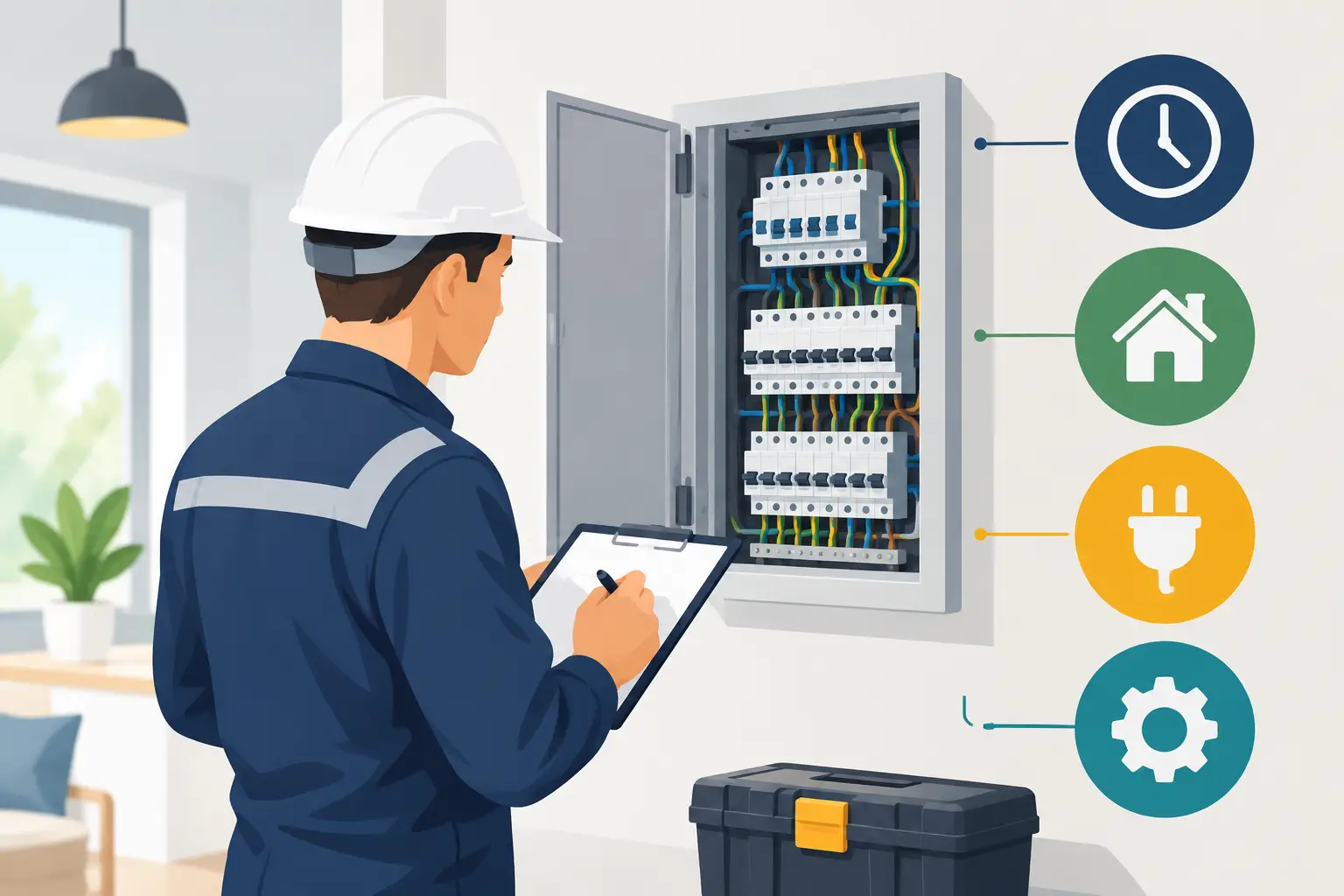
An Electrical Installation Condition Report should be thorough enough to give you confidence in the safety of the installation, not rushed to meet an arbitrary appointment slot. EICR inspection duration varies significantly between properties, but understanding what affects the timescale makes it easier to plan access, minimise disruption and arrange any follow-up work without surprises.
How long does an EICR inspection take?
For a small, modern flat with a straightforward consumer unit and good access, an EICR may take around one to three hours. A typical three-bedroom house can often take three to five hours, while a larger property, an older installation or a property with several consumer units may take longer.
Commercial, industrial and communal properties require a separate assessment. A small office may be inspected within a day, but a warehouse, school, block of flats or premises with machinery can require several days of testing. The electrician must account for the number of circuits, the complexity of the distribution system, working hours and whether areas can safely be isolated.
These are useful planning estimates rather than fixed promises. A qualified electrician should allow enough time to inspect and test properly, then record the findings accurately.
What happens during an EICR?
An EICR is an assessment of the fixed electrical installation. It does not test portable appliances such as kettles, computers or extension leads. The inspection covers the condition of the consumer unit or distribution board, cabling, sockets, switches, lighting circuits, protective devices, earthing and bonding arrangements.
The electrician begins with a visual inspection, looking for signs of damage, overheating, unsuitable alterations, missing protection or equipment that no longer meets the expected safety standard. They then carry out electrical tests on the relevant circuits. These can include continuity, insulation resistance, polarity, earthing and tests of protective devices.
Some testing must be completed with circuits isolated, while other checks are carried out with the supply energised. This is why a planned EICR may involve short periods without power. In a business setting, this needs careful co-ordination around IT equipment, refrigeration, production lines, alarms and operational requirements.
The report records observations using recognised classification codes. A C1 observation identifies danger that needs immediate action. C2 indicates a potentially dangerous condition requiring urgent attention, while FI means further investigation is needed. C3 observations are improvement recommendations and do not, on their own, make a report unsatisfactory.
EICR inspection duration in homes and rental properties
The number of circuits is usually the biggest factor in a domestic inspection. A compact flat with six circuits is very different from a detached house with separate circuits for an electric shower, garage, outbuilding, cooker, solar PV system, EV charger, garden supply and multiple consumer units.
Age also matters. Older properties can have concealed wiring routes, mixed generations of alterations or fuse boards that need more detailed examination. This does not automatically mean the installation is unsafe, but it can mean additional investigation is necessary before a clear conclusion can be reached.
For landlords, arranging access to every room is particularly important. An electrician cannot fully inspect sockets, fixed accessories or equipment that is blocked by furniture, stock or stored belongings. If areas are inaccessible, the report may need to record limitations, which can affect how useful the inspection is for demonstrating compliance.
In England, private rented properties generally require an EICR at least every five years, or sooner if the previous report recommends an earlier inspection. A satisfactory report can be reassuring for both landlords and tenants, but only if the inspection has been given the time and access it needs.
Why commercial EICRs can take longer
Commercial and industrial installations are rarely as simple as counting sockets. There may be three-phase supplies, sub-main cables, distribution boards, emergency lighting, external areas, plant rooms, specialist machinery and circuits serving critical equipment. Each part needs to be assessed within an agreed scope.
Access and operational constraints can add time. A facilities manager may need to arrange a shutdown window, notify staff and ensure machinery is left in a safe state before circuits are isolated. In some premises, testing is best completed outside normal trading hours or in planned phases to reduce disruption.
A competent contractor will discuss these practicalities before work begins. This helps establish which circuits can be isolated, whether temporary arrangements are required and how any urgent defects will be handled. It is a more reliable approach than carrying out a quick inspection that disrupts operations or leaves important areas untested.
Factors that can extend the inspection time
A longer appointment does not necessarily indicate a problem. It often reflects the size or complexity of the installation. However, several situations can extend the visit beyond the original estimate.
Poor access is a common issue. Consumer units in cupboards, sockets hidden behind heavy furniture, locked stores and inaccessible lofts all slow down the process. Unlabelled circuits can also take time, as the electrician may need to identify what each protective device supplies before testing can be completed safely.
Existing faults and previous alterations may need further investigation. For example, repeated tripping, damaged accessories, signs of heat damage or unusual test readings cannot be ignored simply to keep to schedule. The electrician must identify the concern, make the installation safe where necessary and explain the finding in the report.
Properties with solar panels, battery storage, EV chargers, outbuildings or hot tubs may also need more time. These systems introduce additional circuits and isolation points that must be considered as part of the wider electrical installation.
How to prepare for an EICR
A little preparation can help the inspection run efficiently. Make sure the electrician can access the consumer unit, meters and all rooms covered by the report. Move furniture away from sockets where practical, unlock outbuildings and cupboards, and let the electrician know about any recent electrical work or known faults.
For businesses, provide circuit schedules, previous EICRs and details of any areas that cannot be switched off during working hours. It is also sensible to tell staff in advance that a brief loss of power may occur. This avoids unnecessary concern and allows computers, machinery and sensitive equipment to be shut down correctly.
If you have a solar PV system, EV charger, battery, electric heating or specialist equipment, mention it when booking. Accurate information at the quotation stage helps the contractor allow suitable time and send an electrician with the right experience.
When will you receive the report?
The physical inspection and the report issue are separate parts of the service. Straightforward reports may be completed shortly after testing, but complex findings often need time for careful documentation and review. The report should clearly state whether the installation is satisfactory or unsatisfactory, any limitations that applied, the recommended next inspection date and details of observations.
If remedial work is needed, ask for the findings to be explained in plain language. C1 and C2 observations should be prioritised, while C3 recommendations can usually be planned around budget and future improvement work. Once remedials are complete, appropriate certification or confirmation of the corrective work should be provided.
A well-planned EICR protects more than a compliance deadline. Allow enough time, provide good access and use a qualified contractor who will explain the outcome clearly. For homes, rental properties and workplaces across the Midlands, SDT Electrical Services can help you plan an inspection around the property and the people using it.