
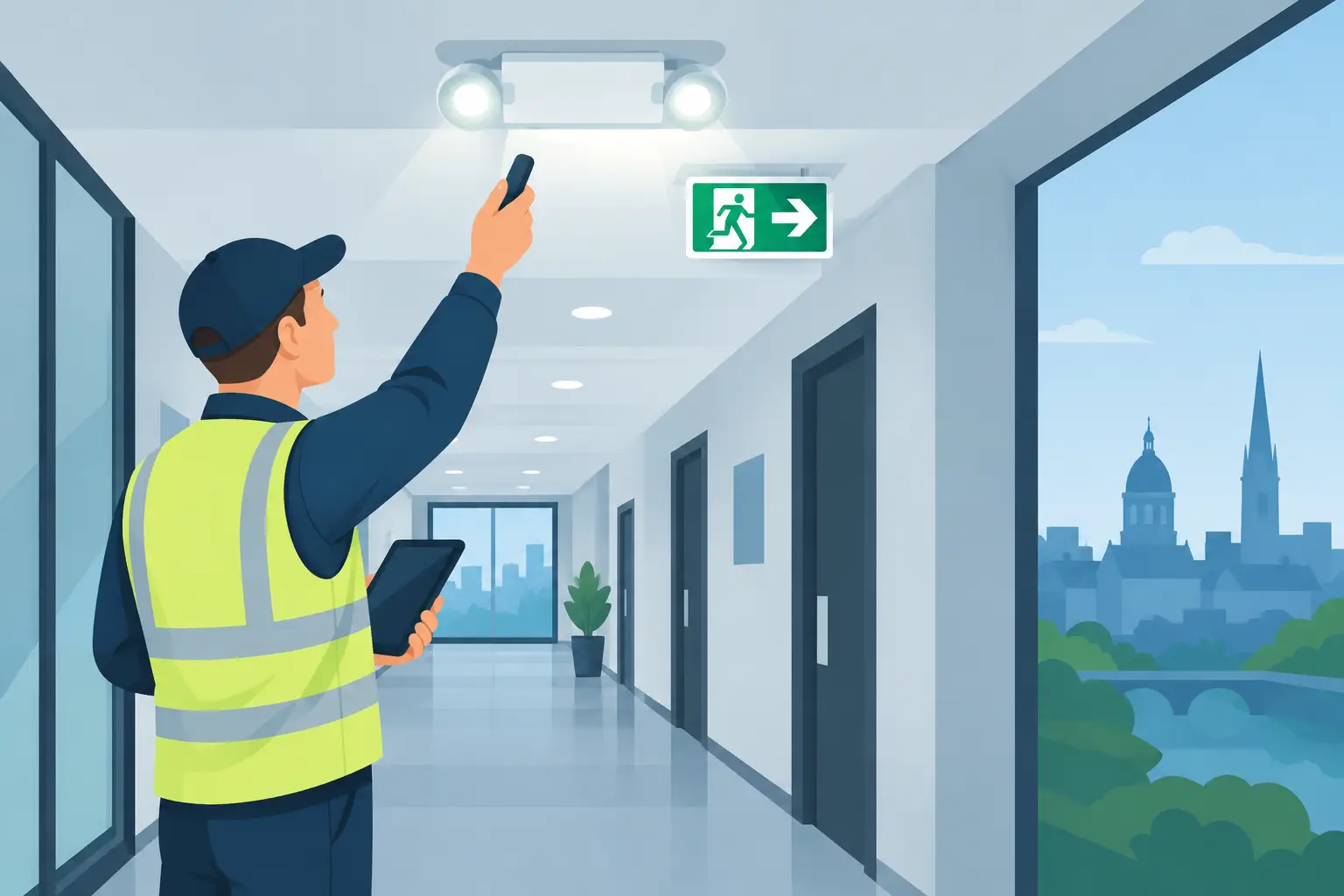
A power cut, fire alarm activation or local circuit fault is the moment emergency lighting has to perform without hesitation. For Nottingham businesses, landlords and property managers, emergency lighting testing Nottingham is not simply a routine box to tick. It is a practical safeguard that helps people find escape routes, stairs, final exits and fire safety equipment when normal lighting is unavailable.
The system may spend most of its life quietly charging in the background, but its condition cannot be judged by appearance alone. Regular testing by a competent electrician identifies failed batteries, damaged fittings, poor illumination and record-keeping gaps before they become a safety or compliance issue.
What emergency lighting is designed to do
Emergency lighting provides illumination when the normal mains supply fails. Depending on the building and its fire risk assessment, it may include illuminated exit signs, bulkhead fittings along corridors and stairwells, external lights at final exits, and open-area lighting that prevents panic in larger spaces.
Most systems use self-contained fittings with their own battery and charging components. Others are supplied from a central battery system. Both need planned checks, although the testing approach and maintenance requirements can differ.
The purpose is straightforward: occupants must be able to leave safely, and any person remaining in the building should be able to locate essential safety equipment. A fitting that illuminates weakly, goes out after a few minutes or fails to operate at all does not provide that reassurance.
Why emergency lighting testing in Nottingham matters
Fire safety duties apply to many non-domestic premises, including shops, offices, warehouses, communal areas of residential buildings, schools, care settings and industrial units. The responsible person must take reasonable steps to protect occupants and maintain fire safety measures. Emergency lighting is often part of those measures.
A suitable fire risk assessment determines whether emergency lighting is required, where it should be positioned and how long it needs to operate. In many premises, the specified duration is one or three hours. The right arrangement depends on the building, occupancy, evacuation strategy and risks present, rather than a one-size-fits-all decision.
For landlords and managing agents, communal staircases, corridors, plant rooms and car parks deserve particular attention. For commercial and industrial operators, changes to layouts, machinery, racking or shift patterns can alter how people would evacuate. A system that was appropriate several years ago may need review after refurbishment or a change of use.
Regular testing also supports clear evidence of compliance. Should an incident occur, a complete logbook demonstrates that checks were planned, faults were identified and repairs were arranged. Missing records can make a well-maintained installation difficult to prove.
The usual testing schedule
Emergency lighting is normally tested at intervals in line with the system design, relevant standards and the building’s fire safety arrangements. British Standard guidance commonly informs the process, but the exact regime should reflect the premises and risk assessment.
Monthly functional checks
A short functional test is generally carried out each month. This simulates a mains failure long enough to confirm that emergency fittings and signs operate. It should be timed so batteries are not left significantly discharged when the building needs to be occupied, especially where a full-duration test is due or the premises operates around the clock.
During the check, the person carrying it out should look beyond whether lamps switch on. Dim output, flickering, damaged diffusers, faulty charge indicators, obstructed signs and poor visibility along an escape route all require attention.
Annual full-duration testing
A full rated-duration test is usually completed once a year. The normal lighting supply is interrupted in a controlled way and the emergency system is allowed to run for its designed duration. This confirms that batteries can sustain the required output rather than merely illuminate briefly.
A full discharge test needs careful planning. Once batteries have been depleted, they need sufficient time to recharge. Carrying out the test when the building is empty or at low risk is often sensible. If a fault is found, temporary controls may be necessary until the fitting or battery has been repaired or replaced.
Daily and periodic visual checks
Some premises need more frequent visual checks, particularly where a central battery system, test panel or monitored installation is used. Building staff may check indicators, fault warnings and physical condition between formal tests. These checks can be simple, but they should still be recorded where required by the site’s procedures.
What a professional inspection should uncover
Emergency lighting faults are not always obvious to a facilities team or landlord. Battery capacity naturally reduces with age, so a unit may pass a brief monthly test but fail before the end of a longer annual test. Older fittings can also suffer from corroded terminals, failed chargers, loose connections or incompatible replacement lamps.
A qualified electrician can test the installation safely, assess its operation and identify faults that need remedial work. They can also consider whether the system still serves the building as it is used now. For example, a former storage room turned into an office, a reconfigured warehouse aisle or a newly enclosed corridor may need additional coverage.
This is where testing and maintenance work together. Testing reveals the issue; appropriate remedial work restores protection. Replacing a battery may be sufficient in one fitting, while another may be better replaced entirely due to age, damage or poor light output. LED emergency fittings can reduce routine energy use and often offer improved reliability, but the suitability of any upgrade should be assessed for the existing installation.
Keep an emergency lighting logbook
A logbook is one of the most useful parts of an emergency lighting maintenance plan. It gives property managers, duty holders and inspectors a clear history of what was checked, when it was tested and what happened afterwards.
Each entry should record the test date, the type and duration of test, the person carrying it out, any faults found and the action taken. Keep details of replacement parts, repairs and any alterations to the system. If a fitting cannot be repaired immediately, record the interim safety measures and the date the issue was resolved.
Paper and digital logbooks can both work well, provided the information is complete, accessible and kept up to date. The key point is consistency. A number of unsigned entries completed long after the event offers far less confidence than a clear, live record.
When to arrange testing sooner
Do not wait for the next scheduled test if the building has changed or a fault is suspected. Arrange an inspection following electrical works, a fire safety review, water damage, vandalism, a prolonged power issue or refurbishment affecting escape routes.
It is also sensible to act when an emergency fitting has visible damage, a charge indicator is not showing correctly, an exit sign is obscured or a monthly test produces inconsistent results. In a tenant-occupied building, reports of lights not working in communal areas should be treated promptly. These are safety systems, not cosmetic fittings.
Choosing the right electrical contractor
The best contractor will do more than operate a test switch and leave. Look for qualified, insured electricians who understand commercial, industrial and residential common-area installations, can provide clear test records and can complete remedial work where faults are found.
It also helps to use a contractor with wider electrical capability. Emergency lighting concerns can sometimes be linked to damaged circuits, poor alterations, ageing distribution equipment or wider issues identified during an Electrical Installation Condition Report. One dependable team can investigate the cause and coordinate the right repair without unnecessary delay.
SDT Electrical Services Ltd provides professional emergency lighting testing and electrical support for properties across Nottingham and the wider Midlands. A planned testing arrangement can be tailored around your building’s hours, occupants and operational requirements, with clear advice where repairs or upgrades are needed.
A dependable emergency lighting system is easiest to manage when testing is scheduled before there is a problem. Keep records current, act quickly on faults and make sure the people responsible for your premises know who to call when a safety issue is identified.