
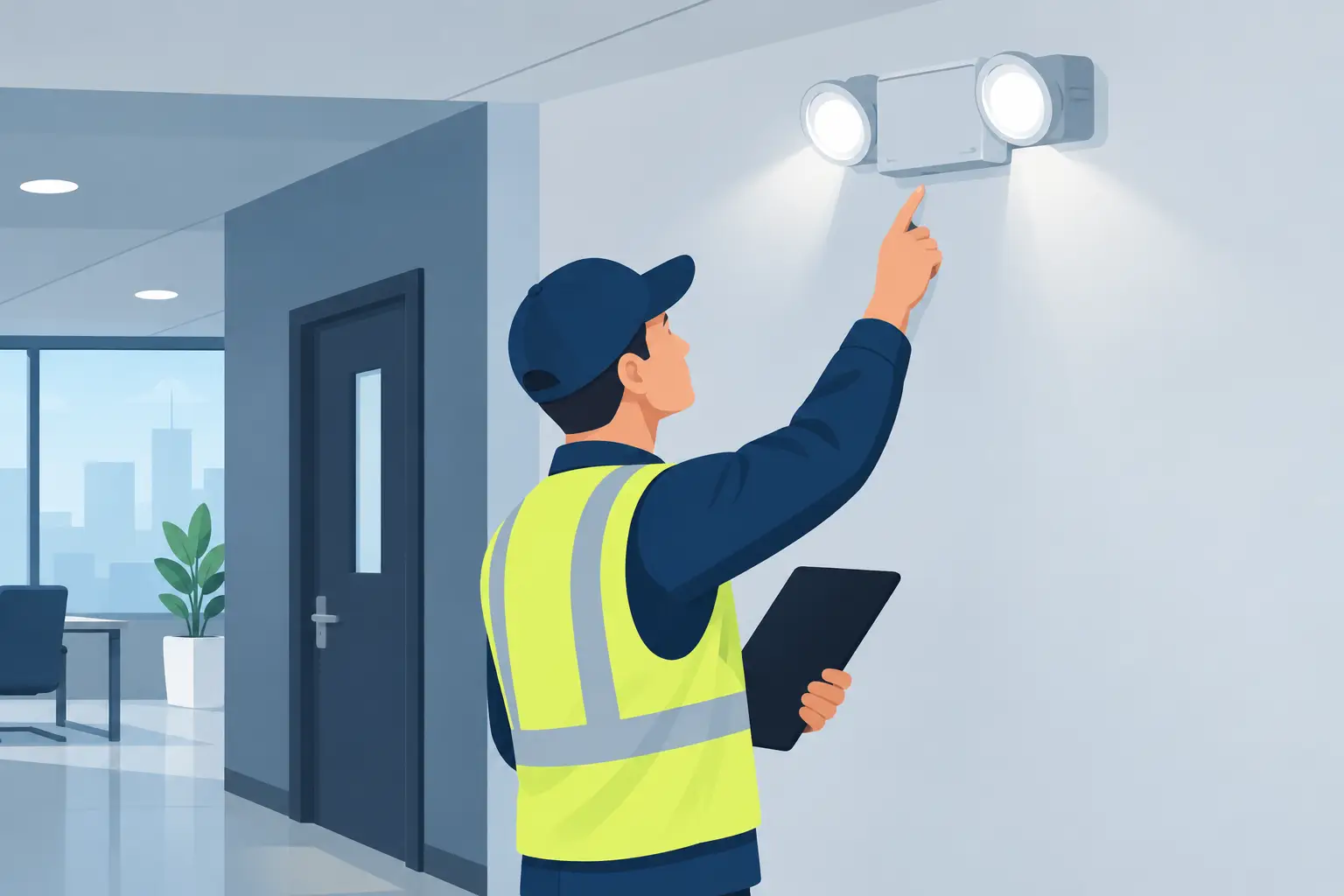
When normal lighting fails, people need to be able to find exits, changes in level, fire-fighting equipment and safe routes without hesitation. Knowing how to test emergency lighting is therefore not simply a maintenance task. It is part of keeping occupants safe and meeting your responsibilities as the person managing a property.
Emergency lighting testing should be planned around the type of system installed, the building’s fire risk assessment and the relevant British Standards. For most workplaces, communal areas and commercial premises, this means regular short functional tests, a longer annual duration test, clear records and prompt action where a fitting does not perform as intended.
What emergency lighting testing checks
Emergency lighting is designed to operate automatically when the normal electrical supply fails. It may be maintained, where the lamp is normally illuminated, or non-maintained, where it comes on only during a power failure. Many modern fittings contain their own battery, while larger sites may use a central battery system or an automatic testing arrangement.
A proper test confirms more than whether a light comes on. It checks that emergency luminaires and illuminated exit signs operate when required, remain on for the expected period, and recharge afterwards. It can also identify damaged diffusers, failed indicator LEDs, loose fittings, obstructed escape routes and signs that have become difficult to see.
The required emergency duration is commonly one or three hours, but it depends on the premises and its fire safety design. A fitting that lights briefly but cannot sustain its rated duration has not passed the test.
Before you test emergency lighting
Testing deliberately simulates a loss of normal power. That can leave corridors, stairwells and exit routes with reduced light for a period, so choose the timing carefully. Do not carry out a test when the building is busy, when daylight is poor, or when people could be put at risk by reduced visibility.
Tell relevant staff, tenants, security personnel or other occupants that a test is taking place. If your building has a monitored fire alarm, building management system or security system, establish whether the test could create a fault signal or alert. Make suitable arrangements before starting.
You should also have access to the emergency lighting logbook, system drawings where available, and the test key or control panel. The test key must only operate the emergency lighting test circuit. It should not be used to isolate supplies unnecessarily or interfere with other essential systems.
For complex premises, central battery installations, high-risk industrial areas or sites with vulnerable residents, testing should be undertaken or overseen by a competent electrical professional. The person responsible for the premises remains responsible for ensuring that the system is maintained and records are kept.
How to test emergency lighting: the monthly function test
A monthly test is usually a short functional check. Its purpose is to confirm that the emergency lighting transfers to battery operation and that each fitting illuminates. The exact frequency and process should reflect your fire risk assessment, manufacturer instructions and maintenance plan.
Start by carrying out a visual check. Look for obvious damage, missing covers, fittings that have been painted over, blocked exit signs, failed charge indicators or emergency lights obscured by storage, displays or temporary works. In communal areas of flats, pay particular attention to stairs, landings, corridors and final exits.
Next, operate the dedicated emergency lighting test switch or use the approved test facility. This simulates failure of the normal supply to the emergency lighting circuit without shutting down the whole building. Walk the escape routes and check that every relevant emergency luminaire and exit sign operates.
Check practical visibility rather than looking at fittings in isolation. Can someone clearly follow the route to a place of safety? Are direction signs visible and correctly orientated? Are changes of direction, steps, external exit points, fire alarm call points and fire equipment adequately lit where required?
After the short test period, restore the normal supply. Confirm that maintained fittings return to normal operation and that battery charge indicators show the expected charging status. If a fitting fails to illuminate, appears very dim, flickers, or does not return to charge, record the fault and arrange repair without delay.
Carrying out the annual duration test
The annual test is more demanding because it verifies that the system can operate for its full design duration. If the system is designed for three hours, it must be tested for three hours. A short monthly test cannot prove this.
Because batteries may be substantially discharged, plan this test for a time when occupants will not need to rely on the emergency system. It is often sensible to conduct it outside normal working hours, with appropriate safety arrangements in place. The building should not be left occupied without adequate emergency lighting while batteries are depleted and recharging.
Operate the test facility and allow the emergency fittings to run for the required duration. Inspect the installation towards the end of the test, not just at the start. This is when weakened batteries and failing lamps are most likely to become apparent. Emergency signs should remain legible and routes should continue to have usable illumination throughout.
Restore the supply once the test is complete and check that charging resumes. Allow sufficient recharge time before assuming the system is fully available again. If the annual test exposes failures, take proportionate action immediately. Depending on the risk, this may include restricting use of an area, providing temporary lighting, increasing supervision or arranging urgent repairs.
Keep an emergency lighting logbook
A test that is not recorded is difficult to evidence later. Your emergency lighting logbook should show the date and time of each test, the person who carried it out, the test type, duration, results, faults found and the action taken to rectify them.
It is also helpful to record replacement batteries, lamps, luminaires and alterations to the layout that could affect escape-route coverage. A logbook gives facilities managers and landlords a clear maintenance history, while also supporting fire risk assessments, inspections and insurance enquiries.
Automatic testing systems can reduce the administrative burden, particularly in larger premises. However, they still need to be reviewed. An automatic report is useful only if identified failures are investigated and repaired.
Common faults that need attention
Battery deterioration is one of the most common reasons for an emergency light to fail its duration test. Batteries have a finite service life and may lose capacity gradually, particularly where fittings are exposed to heat, cold or frequent discharge cycles.
Other frequent issues include failed LED drivers, faulty charge circuits, ageing fluorescent lamps in older fittings, damaged test switches, poor connections and fittings altered during refurbishment. Changes to the building can create a different problem: a previously compliant light may no longer adequately cover an escape route after partitions, racking, signage or room layouts change.
Do not assume that replacing a failed lamp solves the underlying issue. If several fittings fail, trip unexpectedly or show inconsistent charging, a qualified electrician should assess the circuit and the condition of the wider installation.
When professional testing is the right choice
A responsible person can often complete routine visual and simple functional checks where they have been shown the correct procedure. Professional support is advisable for annual duration testing, central battery systems, automatic testing faults, high-rise residential blocks, schools, care settings, industrial premises and any site where a failure could create significant risk.
Emergency lighting maintenance is also separate from an EICR. An Electrical Installation Condition Report assesses the condition and safety of fixed electrical installations, whereas emergency lighting testing focuses on the operation and performance of the life-safety lighting system. Both may be needed, but one does not replace the other.
For businesses, landlords and property managers across the Midlands, SDT Electrical Services Ltd can inspect, test and maintain emergency lighting as part of a practical electrical safety plan. A qualified electrician can also advise when alterations, battery replacements or additional fittings are needed following a change in building use.
The best time to find an emergency lighting fault is during a planned test, not during a power cut or evacuation. Set a testing schedule that reflects your premises, keep accurate records and treat every failed fitting as a safety issue until it has been properly resolved.