
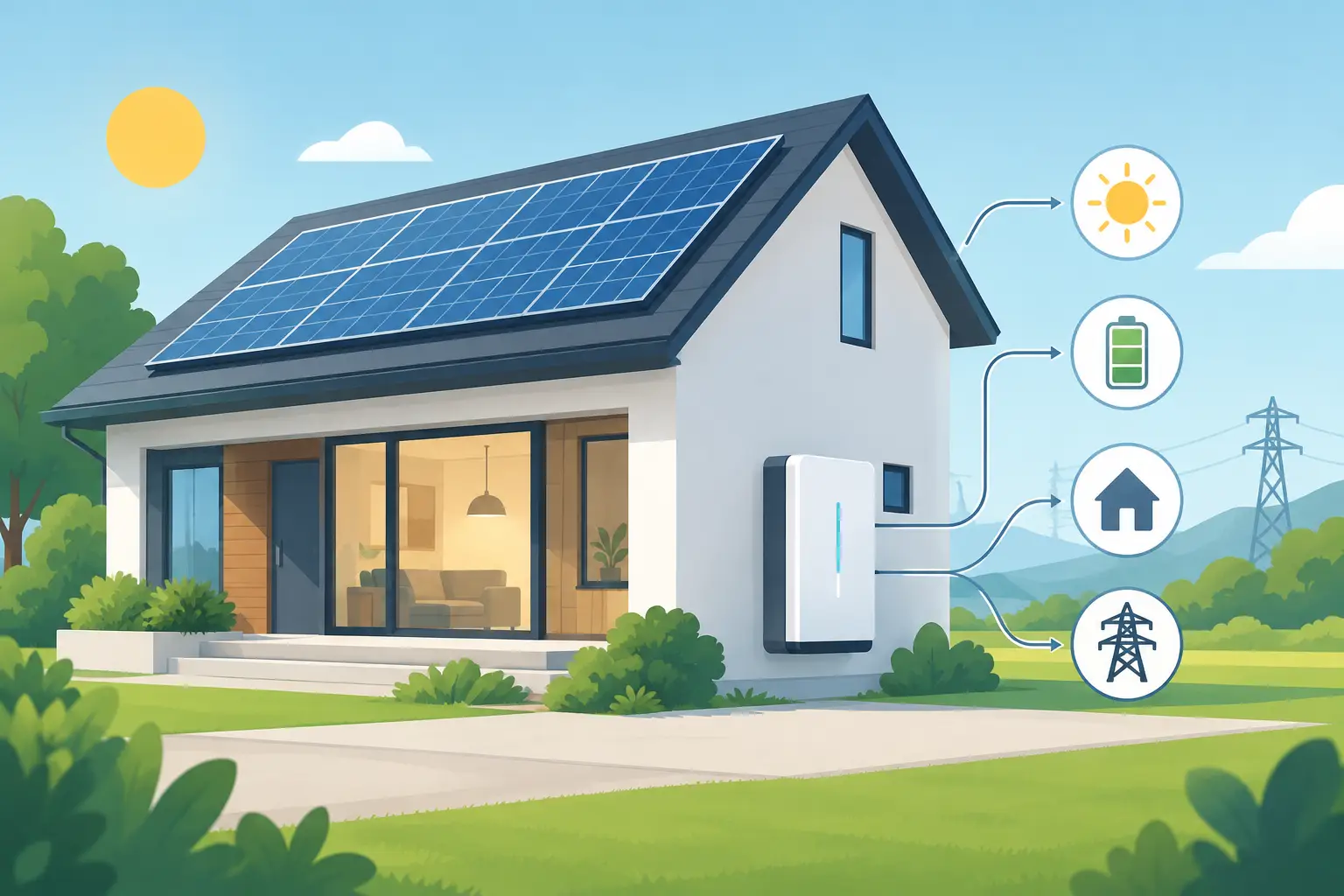
A solar array can generate plenty of electricity at midday, just as a household or workplace is using less of it. Battery storage changes that pattern by retaining surplus generation for later use, rather than automatically exporting it to the grid. For many property owners, that can make solar more useful after work, during the evening and at other times when energy demand is higher.
A battery is not automatically the right answer for every property. Its value depends on how much electricity you generate, when you use it, your current tariff and the condition of the existing electrical installation. A properly designed system should be based on real usage, safe installation and clear expectations, not a one-size-fits-all package.
How battery storage works alongside solar
A home or commercial battery stores electrical energy, usually produced by solar panels, in a form that can be used later. When generation exceeds demand, the system directs available surplus into the battery. When solar output falls, the battery can discharge to supply selected loads in the property before electricity is imported from the grid.
Most systems are managed automatically by an inverter and monitoring platform. You can usually see solar generation, battery charge level, household consumption and grid import in an app. This visibility is useful, but it should not replace sound electrical design. The battery, inverter, protection devices and connection to the consumer unit all need to be suitable for the property.
Battery storage can also charge from the grid where this suits the tariff and system settings. For example, a property on a time-of-use tariff may charge overnight at a lower rate, then use stored electricity during higher-cost periods. Whether this delivers worthwhile savings depends on the difference between tariffs, battery capacity, charging losses and daily energy use.
When a battery is likely to make sense
Battery storage is often a strong option for homeowners who already have solar panels and regularly export electricity during the day, only to buy power back in the evening. It can increase the proportion of your own generation used on site, sometimes called solar self-consumption.
It may also suit a new solar installation where the aim is to reduce grid reliance and make better use of generation throughout the day. Families who are out during working hours, for instance, may produce most of their solar energy when the house is quiet. A battery can hold some of that energy for cooking, lighting, appliances and other evening use.
For commercial premises, the case is more individual. A small office, workshop or retail unit with predictable daytime demand may already use much of its solar generation directly, reducing the need for a large battery. A site with changing operating hours, overnight consumption or costly peak-period imports may see a better opportunity. Load data matters more than assumptions.
An electric vehicle can affect the calculation too. Charging an EV at home can use a large amount of energy, but the timing is crucial. If the vehicle is normally charged overnight, a low-rate tariff may be more economical than using a domestic battery. If it is present during sunny daytime hours, solar charging may reduce the need to store that electricity first.
Choosing the right battery size
The largest battery is not necessarily the best investment. Oversizing can leave capacity unused for long periods, while undersizing may mean the battery fills early and still leaves significant solar generation exported. The right size is based on a balance of generation, consumption and budget.
A qualified electrician will normally consider your typical daily electricity usage, daytime export, evening demand, solar array output and the rating of the inverter. Seasonal variation is important as well. Solar generation is substantially lower in winter, so a battery that often fills in summer may not fully charge for long periods during darker months.
Battery capacity is commonly shown in kilowatt-hours (kWh), while power output is shown in kilowatts (kW). Both figures matter. Capacity indicates how much energy can be stored. Power output affects how much the battery can supply at any one moment. A system with adequate capacity but limited output may not cover several high-demand appliances operating together.
It is also worth checking the usable capacity rather than only the headline figure. Batteries are not generally designed to be discharged completely, as protecting a minimum level of charge can help preserve their working life. Manufacturers may express this differently, so comparisons should be made carefully.
Start with your actual energy pattern
Smart meter information, electricity bills and inverter monitoring can provide a more realistic picture of consumption than estimates alone. Look at when energy is used, not simply the total monthly figure. Evening use, overnight baseload and regular high-demand equipment all affect the likely benefit.
For a landlord, property manager or business owner, this may mean reviewing usage across several months and considering changes ahead, such as a heat pump, EV charging points, extended operating hours or new machinery. A system should support the property as it will be used, not just how it was used last year.
Safety, compliance and installation requirements
Battery storage is a significant electrical installation. It should be installed by competent, appropriately qualified electricians who understand the equipment, applicable regulations and the requirements of the local distribution network operator.
The location needs careful thought. Batteries should be fitted in a suitable area with adequate clearance, protection from damage and conditions that fall within the manufacturer’s stated temperature range. Garages, utility areas and dedicated plant spaces are commonly considered, but the right location varies by property and product. Access for inspection, maintenance and emergency response should not be overlooked.
The existing consumer unit and electrical supply must also be assessed. Some properties require upgrades to accommodate the additional equipment safely. Suitable isolation, circuit protection, labelling and earthing arrangements are essential. Where the installation is connected to the grid, the installer must also ensure the required notification or approval process is followed.
For properties with older wiring, signs of damage, recurring tripping or an overdue electrical inspection, it is sensible to address those issues before adding solar or battery equipment. An Electrical Installation Condition Report can identify concerns that may affect the safety or suitability of the proposed work.
Will a battery keep the power on in a cut?
Not always. This is one of the most common misunderstandings around battery storage. Many standard systems shut down during a power cut to protect electrical workers who may be repairing the network. Having a battery installed does not, by itself, provide backup power.
Some systems can be designed with backup or emergency power capability. This may supply a dedicated circuit, selected essential loads or, in some cases, a larger part of the property. The design needs to be agreed from the outset because it can require additional equipment, a changeover arrangement and clear limits on what can be powered.
A backup system should be sized realistically. Keeping lights, broadband, refrigeration and a few sockets operating is very different from running an electric shower, cooker, heat pump or industrial machinery. Discuss what you need to remain operational during an outage, rather than assuming every circuit can be supported.
Costs, lifespan and realistic expectations
The installed cost of battery storage varies with capacity, inverter type, backup requirements, site complexity and whether it is being added to an existing solar system. Retrofitting is possible in many cases, but compatibility should be checked. Some systems use an AC-coupled arrangement, while others are designed to work more closely with a hybrid solar inverter.
Batteries gradually lose capacity over time. Most manufacturers provide a warranty based on a number of years, a throughput limit, or both. Read the warranty terms closely, including the retained capacity promised at the end of the period and any conditions around registration, monitoring or installation.
Savings should be treated as an estimate, not a guarantee. Electricity prices, export rates, weather and household routines change. The strongest proposals explain where the expected benefit comes from, what assumptions have been made and where the limitations are.
Planning a battery storage installation
Before choosing equipment, arrange a site assessment that considers your existing electrical installation, solar system where applicable, energy use and future plans. Ask how the system will be sized, whether it can provide backup power, what monitoring is included and how the equipment will be isolated and protected.
For homeowners and businesses across the Midlands, SDT Electrical Services can provide practical advice on solar and battery installations, with qualified electrical work focused on safety, compliance and reliable performance. The best battery system is the one that fits your property, your energy habits and the way you expect to use electricity in the years ahead.