
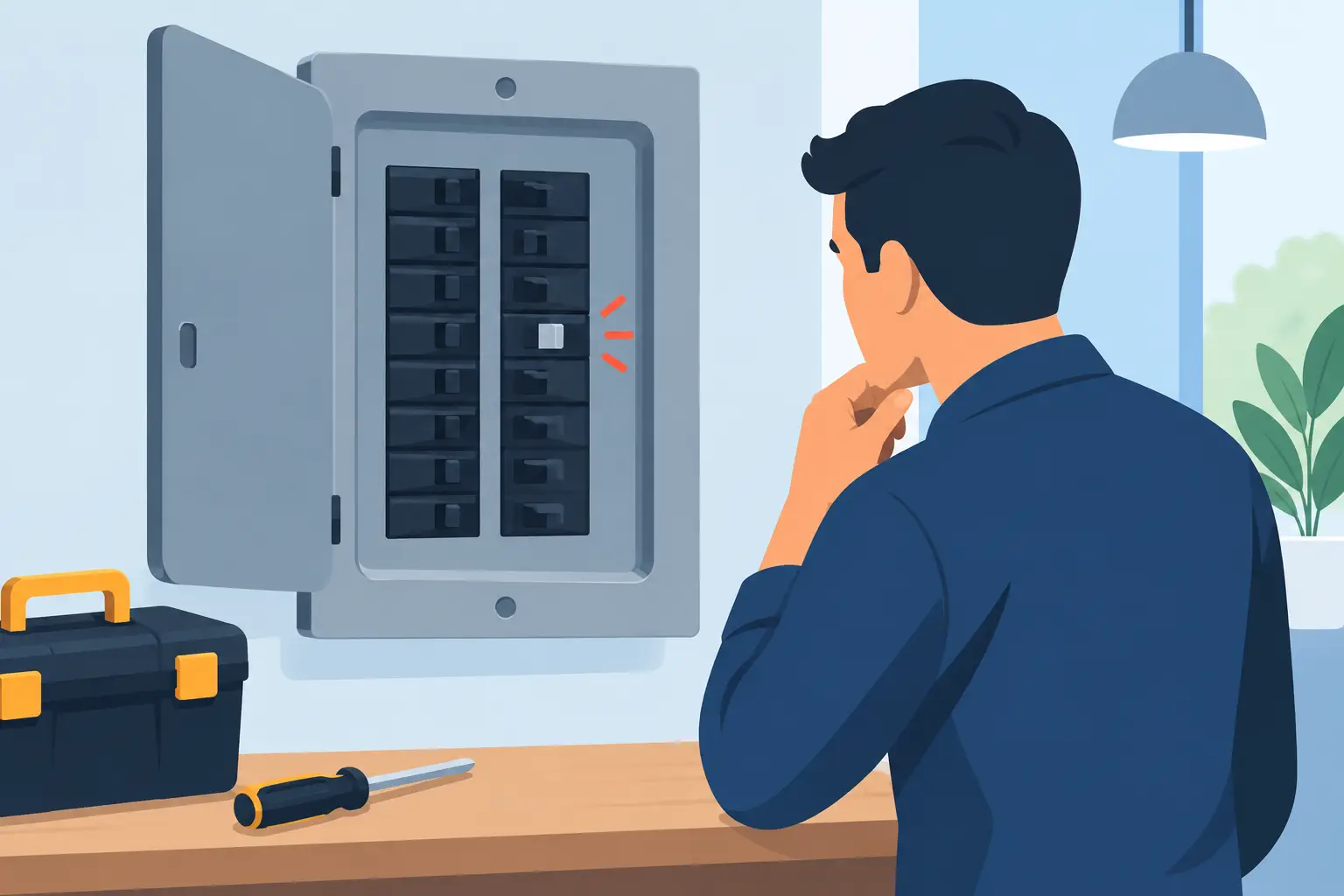
A circuit breaker tripping halfway through cooking dinner, starting machinery or charging an EV is more than an inconvenience. It is the electrical installation responding to a condition it considers unsafe, and repeatedly forcing it back on can turn a manageable fault into damage, electric shock or fire risk.
A single trip after plugging in a suspect appliance may have a straightforward cause. Repeated tripping, a breaker that will not reset, or any sign of heat or burning needs a more cautious response. Knowing what the consumer unit is telling you helps you act safely while keeping disruption to your home, rental property or business to a minimum.
Why is your circuit breaker tripping?
A circuit breaker is designed to disconnect power when too much current flows through a circuit. This protects cables from overheating and helps prevent damage to the electrical installation. In newer consumer units, an RCBO may provide both overload protection and additional protection against earth leakage. An RCD protects against earth leakage across a group of circuits, so it can also trip even where no individual breaker appears to have moved.
The exact type of device matters, but the message is the same: something requires attention. The most common causes are overload, a faulty appliance, a short circuit, earth leakage, water ingress, or a fault within fixed wiring or connected equipment.
An overloaded circuit
Overload trips often happen when several high-demand appliances run from the same circuit. Kettles, microwaves, portable heaters, tumble dryers and air fryers can draw substantial power. In commercial settings, it may be power tools, heaters, catering equipment or several items of IT equipment connected to one circuit.
An overload may not happen immediately. A circuit can cope for a short period before the breaker responds to sustained demand. This is why a trip that occurs after several minutes of use can point to excessive load rather than a direct fault. Moving an appliance to another socket is not a lasting fix if the circuit layout or expected demand no longer suits how the property is being used.
A faulty appliance or lead
A damaged flex, worn plug, internal appliance fault or moisture inside equipment can cause a breaker or RCD to trip. Common warning signs include a trip occurring as soon as one appliance is plugged in, when a washing machine begins a cycle, or when outdoor equipment is used in wet conditions.
Unplug the appliance before attempting one reset. If power returns with that item disconnected, leave it unplugged and arrange repair, replacement or professional testing. Do not continue using a lead with exposed insulation, a loose plug, scorch marks or signs of overheating.
Short circuits and earth leakage
A short circuit occurs when live conductors connect where they should not, creating a sudden high current. It may result from damaged cables, loose connections, failed components or a nail or screw penetrating concealed wiring. The breaker will often trip immediately and may refuse to remain on.
Earth leakage is different. It occurs when current finds an unintended route to earth, potentially through damaged insulation, moisture or an appliance fault. RCDs and RCBOs are designed to disconnect quickly because earth leakage can present a shock risk. A trip that happens only in damp weather, when external lighting is switched on, or during use of a particular appliance can be a useful clue for an electrician.
Fixed wiring, sockets and equipment faults
Not every fault is caused by something plugged into a socket. Ageing wiring, deteriorated accessories, poorly made connections, damage from building works, water ingress and unsuitable alterations can all lead to recurring trips. In industrial and commercial premises, faults can also arise in machinery, control panels, motors and cable containment.
If a circuit trips with everything unplugged, or it trips when lights are switched on, treat it as a likely fixed-installation fault. This needs investigation by a qualified electrician rather than trial and error.
What to do when circuit breaker tripping occurs
Start by protecting people, not by restoring power as quickly as possible. Switch off and unplug equipment on the affected circuit where it is safe to do so. Check for obvious concerns such as a damaged lead, a wet external socket or a burning smell, but do not remove consumer unit covers, dismantle sockets or touch exposed wiring.
You can then reset the affected breaker or RCD once. If it stays on, reconnect appliances one at a time, allowing enough time for each to run. When the device trips again, the last appliance connected may be the cause. Stop using it and arrange for it to be checked.
If the device immediately trips again with all appliances disconnected, leave it off. The same applies if you cannot identify which circuit is affected, if the consumer unit feels warm, or if the fault affects essential systems such as lighting, refrigeration, heating controls, alarms or business equipment.
Avoid these tempting but unsafe responses:
- Do not keep resetting a breaker that trips repeatedly.
- Do not replace a breaker with one of a higher rating.
- Do not use extension leads to shift heavy loads around the property.
- Do not attempt repairs inside the consumer unit or fixed wiring.
These actions can bypass the protection intended to keep cables and people safe. A higher-rated protective device, for example, may allow a cable to overheat before it disconnects.
When a tripping breaker is an emergency
Call for urgent electrical assistance if you notice smoke, sparks, crackling, melted plastic, a burning smell, visible heat damage or electric shocks or tingles from an appliance or fitting. If it is safe to do so, switch off power at the main switch, keep clear of the affected area and do not use the installation until it has been assessed.
Water and electricity require particular care. A circuit that trips after flooding, a leak, storm damage or water entering a socket should remain isolated. Do not assume it is safe merely because the surface has dried. Moisture can remain inside accessories, cables and electrical equipment.
For landlords, property managers and facilities teams, recurring tripping should also be recorded and acted on promptly. The fault may affect tenant safety, business continuity or compliance responsibilities, particularly where communal systems, emergency lighting or safety-critical equipment are involved.
Finding the fault properly
A qualified electrician will not simply reset the device and hope for the best. Fault-finding normally begins with a conversation about when the trip occurs, what has changed and which equipment was operating. Testing can then establish whether the issue lies with an appliance, a circuit, protective device, cable, connection or fixed equipment.
Depending on the symptoms, this may involve insulation resistance testing, continuity testing, earth fault loop impedance testing, RCD or RCBO testing, visual inspection and load assessment. In a commercial or industrial setting, the electrician may also check machinery connections, motor loads, control circuits and the suitability of the supply for the equipment in use.
The appropriate repair depends on the diagnosis. It could be as simple as replacing a damaged accessory or as involved as repairing cable damage, redistributing loads, upgrading a consumer unit or improving a circuit for new equipment. Guessing can be expensive, especially if a recurring fault damages appliances or causes avoidable downtime.
Preventing repeat trips
Electrical demand changes over time. A kitchen may gain more countertop appliances, a home may add an EV charger or solar system, and a business may introduce new machinery or expand its IT equipment. Circuits that were adequate when installed may need review when the way a building is used changes.
Use high-load appliances as intended, avoid overloading extension leads and have alterations carried out by competent electricians. Periodic inspection is valuable for older homes, rental properties, commercial premises and sites where equipment is used heavily. An Electrical Installation Condition Report can identify deterioration, defects and departures from current safety standards before they become a disruptive fault.
SDT Electrical Services Ltd provides fault-finding, repairs, EICRs and 24/7 emergency electrical assistance across the Midlands. Where a circuit will not stay on, a qualified assessment gives you a clear answer and a safe route back to normal operation.
A breaker that trips has done an essential job. Leave repeated faults isolated, make a note of what was running at the time, and get the cause investigated rather than relying on another reset.