
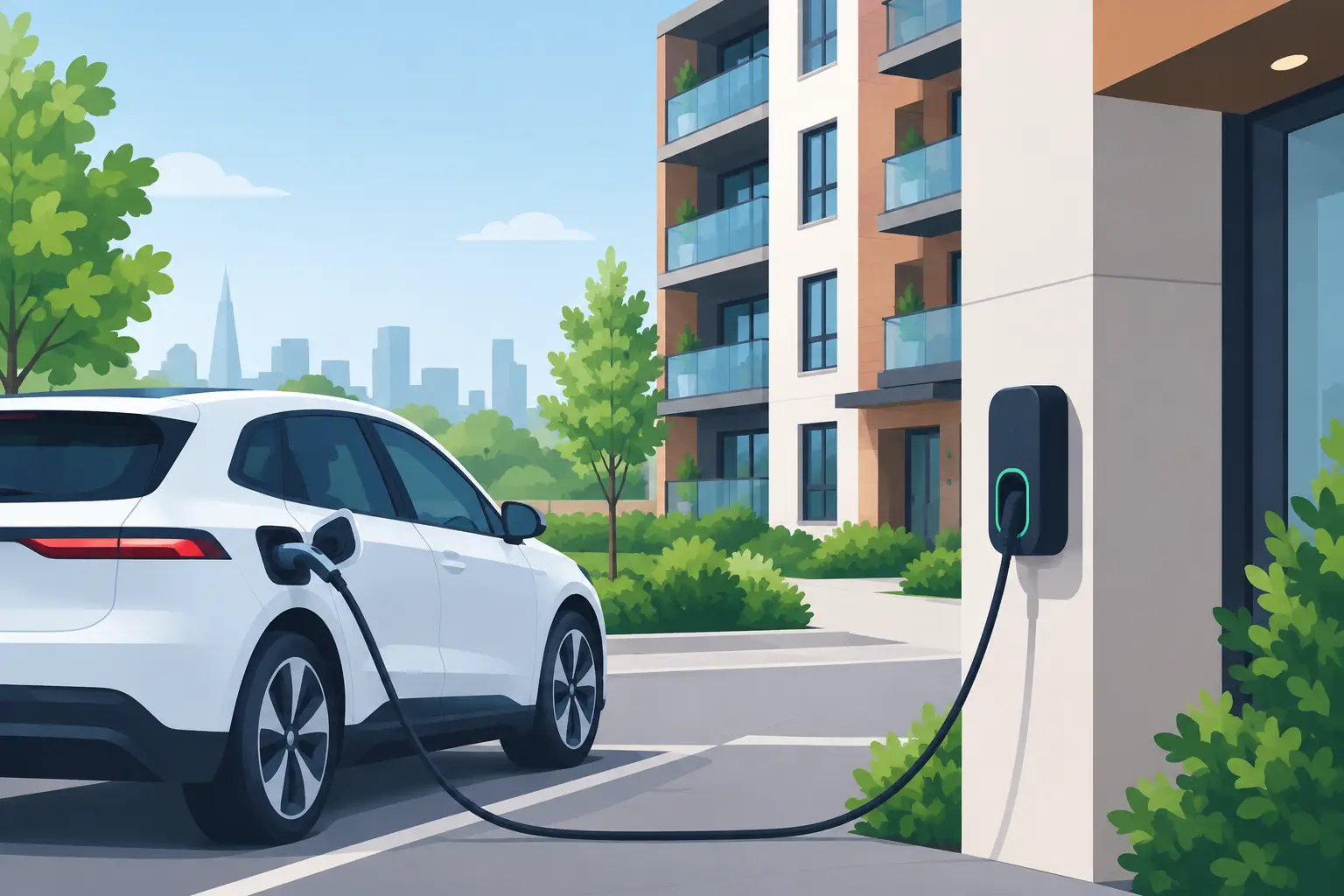
A resident with a new electric car may be ready to charge at home, but fitting an EV charger for flats involves more than choosing a unit and booking an electrician. In a block of flats, the parking space, electricity supply, lease terms and future demand all need consideration. A properly planned installation gives residents a convenient charging option without creating safety, billing or management problems later.
For landlords, managing agents and residents’ management companies, the aim is usually to provide a reliable solution that works for the property now and can expand as more drivers make the switch to electric vehicles.
Choosing an EV Charger for Flats
The right charger depends on who will use it and where vehicles are parked. A single allocated bay close to a flat can sometimes suit an individual charge point, particularly where there is an agreed cable route and a clear way to measure electricity use. Communal car parks usually need a different approach.
In shared parking areas, independently installed chargers can soon become difficult to manage. Cables may take unsuitable routes, several units may compete for limited electrical capacity, and it can be unclear who pays for the energy or maintenance. A coordinated system is normally the safer long-term choice.
Most residential installations use an AC charger, commonly rated at 7kW where the available supply allows. This is suitable for overnight charging for many drivers. Faster charging is not always the best answer in a block of flats: higher ratings can require substantial supply upgrades and increase the overall project cost. The sensible choice is the charger and charging strategy that suits the building’s capacity and residents’ actual needs.
Permission comes before installation
A flat owner does not automatically have the right to install equipment in a communal car park or attach cabling to shared parts of a building. The lease, freeholder or landlord, managing agent and any residents’ management company may all have a role in approving the work.
Before arranging an installation, establish who owns the parking space and who is responsible for the electrical infrastructure. Even an allocated bay may sit on land controlled by the freeholder. Written approval should cover the proposed charger location, cable route, responsibility for future repairs and how electricity will be billed.
For a larger communal scheme, early engagement is worthwhile. Property managers can consult residents, assess likely take-up and set a clear policy for access. This avoids a situation where the first few drivers receive chargers but the building has no sensible route for everyone else.
Planning permission is not required in every case, but listed buildings, conservation areas, unusual external works and site-specific restrictions can change the position. A competent installer can identify the electrical work involved, while the property owner should confirm any property, planning or leasehold requirements before work begins.
Start with the building’s electrical capacity
The electrical supply is often the deciding factor for an EV charger for flats. A site survey should examine the incoming supply, distribution boards, protective devices, earthing arrangements and the condition of the existing installation. It should also consider how the charger cables can be installed without obstructing access routes or compromising the appearance and fabric of the building.
Load balancing protects the supply
A block may have enough capacity for several chargers, but not for every charger to operate at full output at the same time. Smart load balancing monitors demand and adjusts charging rates to keep the installation within safe limits. Residents can still charge their vehicles, while the system avoids overloading the communal supply.
This is particularly useful where electric heating, lifts, communal lighting or other high-demand equipment already place pressure on the supply. It can also reduce the need for an immediate and costly upgrade. However, if the available capacity is very limited, consultation with the electricity network operator may still be needed.
Cable routes need careful planning
The shortest cable route is not necessarily the best one. Routes through communal corridors, stairwells or escape areas need particular care, and cables should not introduce trip risks or interfere with fire safety arrangements. External containment, underground ducting or purpose-designed parking infrastructure may be more appropriate depending on the site.
A survey should also look beyond the first charger. Installing suitable containment or spare capacity during initial works can make later expansion less disruptive and more cost-effective.
Metering and access should be clear
Where residents pay individually, the system needs a reliable way to identify each user and record energy consumption. This might involve an app, RFID card, separate meter or managed charging platform. The best option depends on whether charging is for leaseholders, tenants, visitors or a mixture of users.
Clear rules matter as much as the technology. Residents should know who can use the chargers, how tariffs are set, whether parking time limits apply and who to contact if a unit develops a fault.
Decide who owns and manages the charging system
There is no single model that suits every property. An individual resident may own and maintain a charger serving their private bay, with approval from the relevant property owner. Alternatively, a landlord or management company may own a shared system and recover electricity and maintenance costs through user charging fees.
A managed system can offer better control in a communal car park, especially where multiple drivers need access. It can also make it easier to add chargers later. The trade-off is that someone must oversee user accounts, tariffs, maintenance arrangements and any support calls.
For small blocks, a simpler arrangement may be sufficient. For larger developments, social housing providers and managing agents should think in terms of a site-wide plan rather than individual installations. This gives the property a consistent standard and helps avoid repeated alterations to communal areas.
Installation, testing and certification
EV charging equipment places a sustained electrical load on an installation, so the work should be carried out by qualified, competent electricians. The installation must be designed to the current wiring regulations and manufacturer requirements, with the correct protective devices, isolation and earthing arrangements for the charger and site.
Once installed, the equipment should be inspected, tested and certified. This confirms that the work has been completed safely and provides useful records for landlords, managing agents and future maintenance. Existing electrical concerns should be addressed before a charger is added. An ageing distribution board, damaged cabling or an unsatisfactory inspection result may need remedial work first.
For properties across Tamworth, Nottingham and the wider Midlands, SDT Electrical Services Ltd can assess the practical requirements of a proposed charger installation and provide a clear, no-obligation quotation for suitable works.
Budget for the whole project, not only the charger
The cost of a charger unit is only one part of the project. Installation costs can be affected by distance from the supply, trenching or external containment, distribution board upgrades, metering equipment, data connectivity and whether the electricity supply needs reinforcement.
A single charger close to an existing board may be relatively straightforward. A communal scheme with underground parking, long cable routes or restricted access will need more planning and a larger budget. Asking for a survey-led quotation helps ensure these factors are considered from the outset rather than becoming unexpected extras during the work.
It is also sensible to allow for future maintenance. Chargers are outdoor electrical equipment in many cases, and communal systems may need periodic checks, software support or replacement parts over their working life.
Prepare a proposal residents can understand
A good proposal explains the location of chargers, the number of bays covered, expected charging speeds, how users pay, the electrical capacity available and the approach to future expansion. It should also set out responsibilities for maintenance and faults.
For property managers, this level of detail builds confidence when seeking approval from freeholders or consulting residents. For leaseholders, it answers the practical question behind most requests: can I charge my car at home without causing inconvenience or extra risk for my neighbours?
The strongest EV charging projects for flats are planned around the building, not just the first vehicle. With the right permissions, a proper electrical assessment and certified installation, residents can gain a useful everyday facility that remains safe, fair and ready for future demand.